
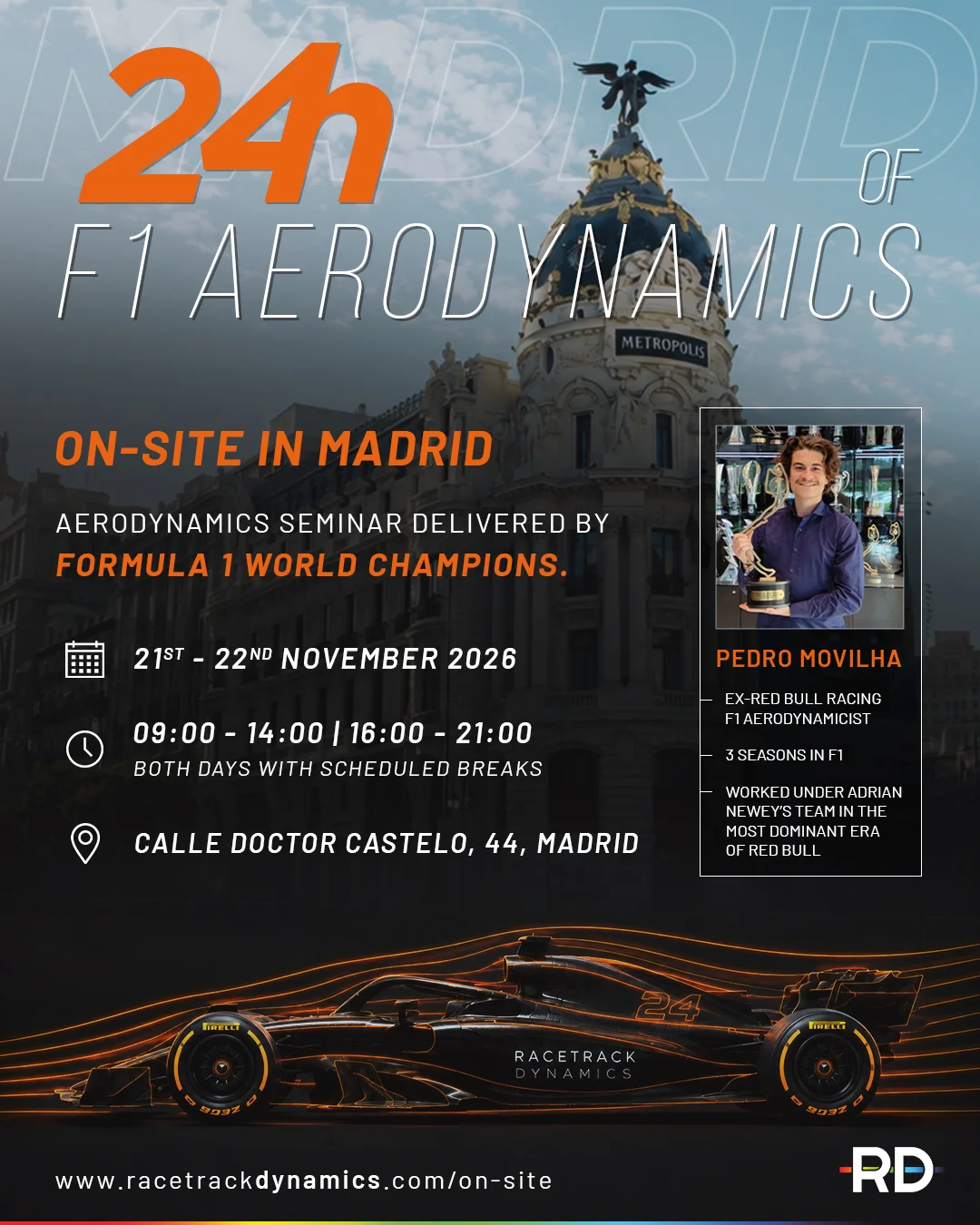
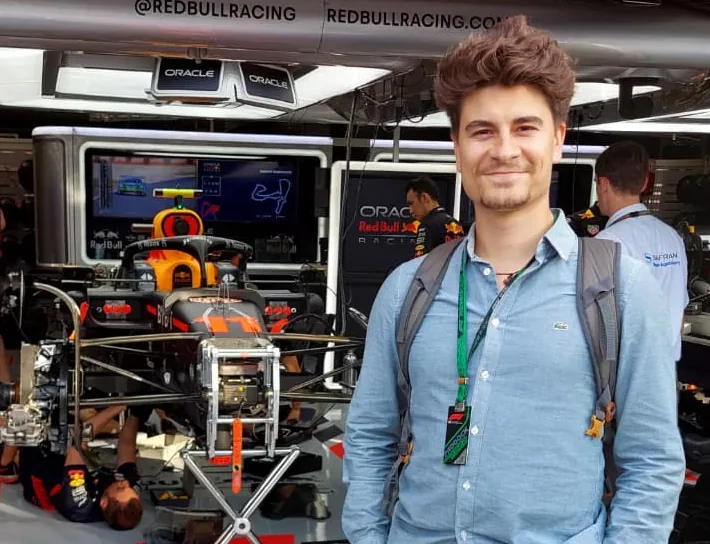
Join us at the 24 Hours of F1 Aerodynamics in Madrid for an immersive deep dive into F1 Aerodynamics, led by Pedro Movilha, an Ex-Red Bull Racing F1 Engineer who worked in Adrian Newey's team.
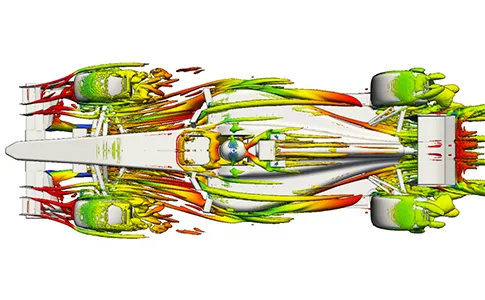
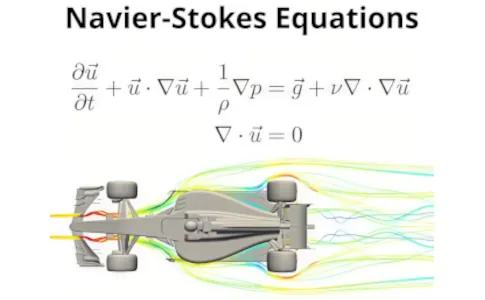
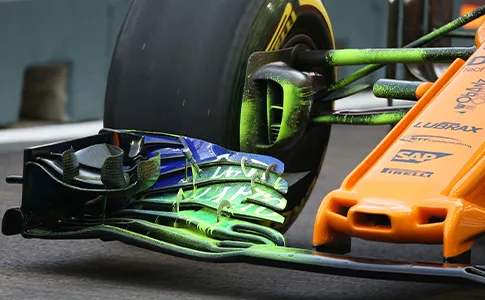
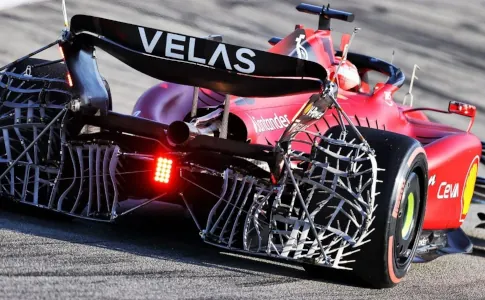
You’ll understand the car as a complete aerodynamic system—from front wing to rear wing—and how every surface collaborates to generate maximum downforce. We’ll bridge theory and practice, showing how fluid mechanics drive development from the first sketch to final on-track performance.
This course won’t just teach you aerodynamics—it will change the way you think as an aerodynamicist. You’ll learn the development philosophy used inside Formula 1, giving you knowledge that is impossible to gain from books or university courses.
You won’t be learning from someone who has only studied aerodynamics and spent years teaching the same university material. You’ll be learning from engineers who have developed Formula 1 cars at the highest level, where every idea, every assumption, and every design decision is challenged by some of the best engineers in the world.
Unlock the confidence to discuss real aerodynamic development in interviews, produce stronger engineering work, and differentiate yourself in one of the world’s most competitive industries.
Our commitment is simple: to accelerate your journey and help you become the strongest engineer you can possibly be.
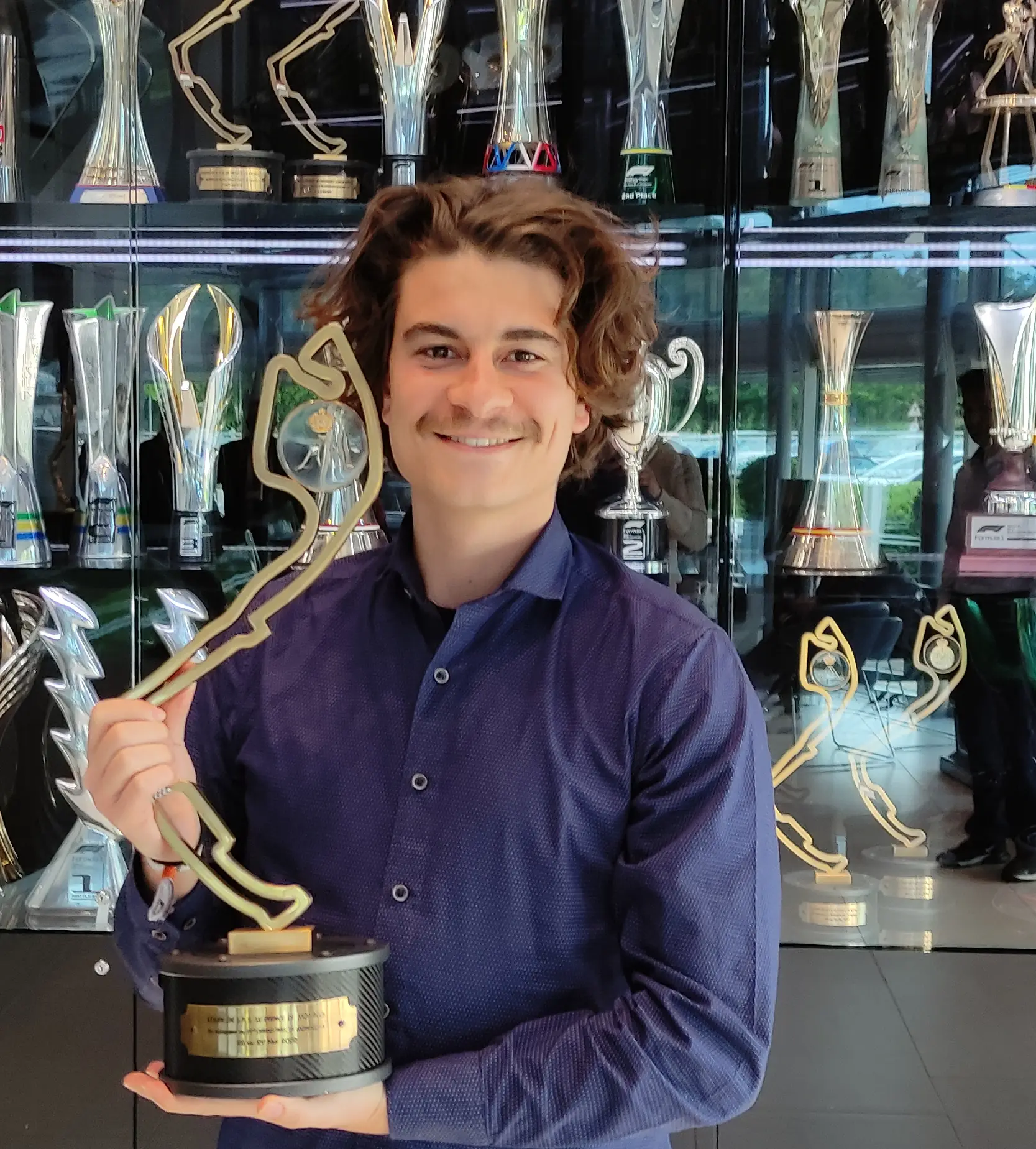
My name is Pedro Movilha Silva, and I come from Lisbon, Portugal, where I was a member of the FST Lisboa Formula Student Team for 2 years. In 2021, in the same day I had finished my MsC in Aerodynamics from Instituto Superior Tecnico in Lisbon, I was starting my career as an Aerodynamics Engineer in Red Bull Racing.
In F1 I have learned that despite being complementary, theory and practice are indeed different things. Learning in Uni about Physics, Mathematics, and Aerodynamics is one thing. Still, nothing prepares you better to F1 than this: experiencing it. Obviously, you cannot experience a place where you have never been (yet). Therefore, I have dug really deep into my memory, and tried to recall every moment in my F1 career where I wished someone would had explained "that" to me before.
In this course, I have compiled the knowledge those moments have brought me: the insights, the ways of thinking, the ways of working. My goal here was to produce a guide that I wish my pre-F1 self had access to. Ranging from how the aero development influences car characteristics, to the interactions of the different aero parts in the car, from the wind tunnel details to the sometimes complicated transition between University/Formula Student and the F1 world.
I have tried, in an intuitive way, to explain the most important concepts an F1 aerodynamics engineer should grasp and I have a responsibility towards you to provide the best material I can, and to guide you as best as we can, as I wish someone had done with me before we started my F1 careers. This course follows that mantra. I am eager to pass our knowledge to you, and I want to help you to think better as an F1 engineer!
Before August 20th
After August 20th
Join our newsletter
Get the latest updates on new courses, exclusive insights from F1 engineers, and special offers delivered to your inbox.

Racetrack Dynamics 2026 All Rights Reserved