{{score}} out of 10
After you watch this video, you'll be able to view the answers to the Vehicle Dynamics exam by clicking below.
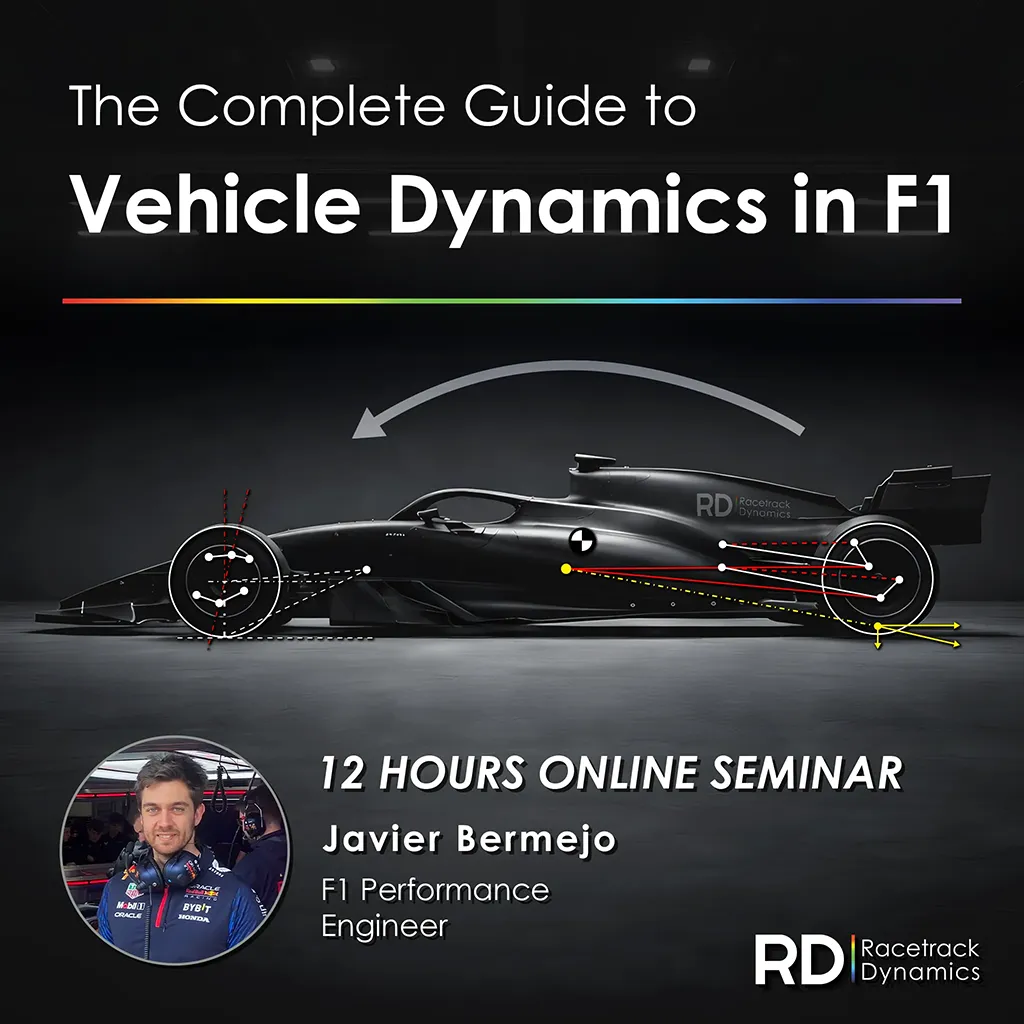
The Complete Guide to Vehicle Dynamics in F1 packs all the information needed to evaluate, assess, and create any performance-oriented racecar, including countless explanations drawn from direct examples in F1 and motorsport taken from Javier's experience.
The five fundamental pillars are:
Tire Performance.
Unpacking the different operational modes of tires, quantification of the most relevant tire properties and metrics. Discovering how tire models are created and how longtitudinal and lateral force generation is combined in the real world. We also explain the science behind the optimal camber and toe setups, without forgetting about tire load sensitivity, the critical factor affecting the setup choices of all racecars. We finish off by diving into temperature management, how real-world tire testing works, and showing examples of tools you can create to analyze tire performance and compare different compounds.
Lateral Dynamics.
This chapter investigates the mathematical properties of under and oversteer, and how they can affect different stages of a turn (entry/apex/exit). We then look at how yaw is produced and we link it to the operating modes of the tiress. To finish off we look at frequency response analysis, the real world solution for assessing car handling and performance and we provide the equations to build a bycicle model in your own time (as we provide the slides for you to keep forever).
Weight Transfer.
Here we explain the extremely important concept of weight transfer and how it affects different parts of the car separately. Deep diving into the analysis of car roll and into the mathematics of how to control it. Then diving into mechanical balance (not to confuse it with weight distribution). We then move onto brake balance (and brake balance migration) along with some real world F1 examples on how to maximize braking performance. We finish off explaining advanced strategies for vehicle performance via mechanical balance migration.
Simulation and Performance.
Here we analyze different ways of assessing vehicle perfomance, both via simulation and with real-world testing, we also discuss state-of-the-art simulation tools used in F1 top teams (without revealing sensitive information). We then dive into how a vehicle dynamicist would manage aerodynamics (as it's a major element of performance) and how to correctly setup the aerodynamics elements of a car from a performance perspective. We finish off by linking back to a lot fo the content covered in previous topics, and explaining the nuances and performance tradeoffs.
Suspension Design.
Here we bring everything together, uniting all the concepts learned throughout the course into a cohesive recipe for building a performant suspension. We look at the key points and metrics to get right, anti-squat/dive/lift, different types of steering modes, and the usual factors you would expect, toe, camber, camber gain, etc.
All of this through 12 hours of intense learning from Javier, designer of Max Verstappen's suspension and currently Nico Hulkenberg's Performance engineer, who will take care of you and ensure everything is clear and well understood.

Racetrack Dynamics 2026 All Rights Reserved